The Monterey Bay Aquarium Rebuilt Its Family Gallery Around the Penguins
November 12, 2026
November 12, 2026
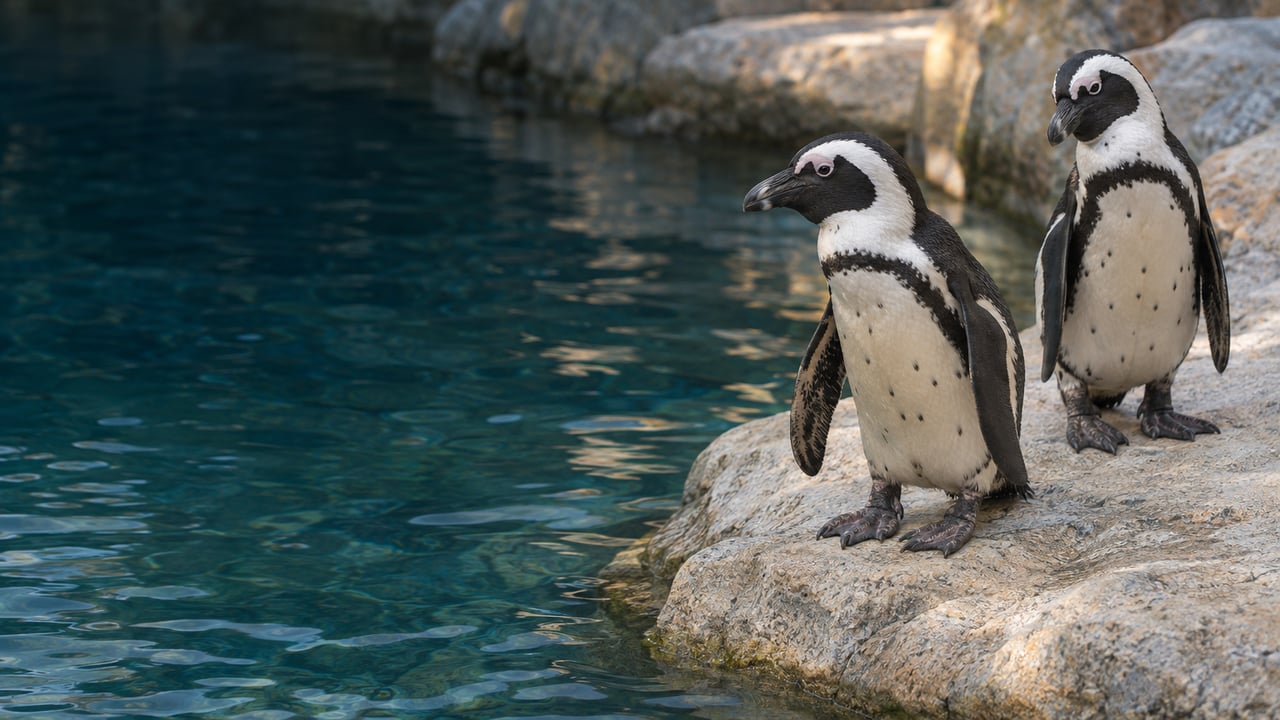
The Monterey Bay Aquarium's second-floor family gallery, next to the Kelp Forest, has been rebuilt twice in 26 years. The penguins came through the 2008 rebuild as a returning favorite, and this fall's rebuild puts them at the center of the room. Ocean in Motion / La Danza del Mar opened on Saturday, November 7, and replaces the Splash Zone. Its centerpiece is a much larger African penguin habitat. It sits among a coral reef, seahorse towers and leaping fish, and all of them ask children to move like the animals in front of them.
Some of the birds in that habitat are older than the gallery around them.
The Splash Zone opened in April 2000. According to the Aquarium's own history, it was the first children's museum ever built inside an aquarium. It was meant to be temporary, but it was popular enough that it became permanent.
Eight years later the Aquarium rebuilt it as "Splash Zone: Ocean Homes," which opened March 17, 2008. The 2008 press kit said the expansion doubled the family space and split it into three habitats: the Enchanted Kelp Forest, Coral Reef Kingdom and Rugged Rocky Shore. The same release promised that visitor favorites would stay, and the first one it listed was "the colony of blackfooted penguins."
The three versions of the room line up like this:
| Version | Opened | Organizing idea | Role of the penguins |
|---|---|---|---|
| Splash Zone | April 2000 | A children's museum inside an aquarium | Not described in the Aquarium's history entry |
| Splash Zone: Ocean Homes | March 17, 2008 | Three ocean habitats to explore, with kelp, coral and rocky shore | A returning "visitor favorite" |
| Ocean in Motion / La Danza del Mar | November 7, 2026 | Moving like the animals to build empathy | A much larger habitat at the center of the gallery |
The 2008 room was built for exploring. Children could crawl through a coral reef cave, make waves along the rocky shore, and look into a 40-foot touch pool at the entrance from the Kelp Forest. The 2026 room is built for copying. When Monterey County NOW toured it, Emily Saich, the Aquarium's vice president of exhibitions, said the team had planned the project for several years and built on the earlier gallery while adding newer research. Monterey County NOW reported that tour on October 26.
The Aquarium's Meet Our African Penguins page profiles 17 birds, and it now sits under the Ocean in Motion section of the website. Several profile dates go back further than the gallery being replaced:
The bird the Aquarium has introduced most often is Rey, whose name is short for Monterey. She hatched at the Aquarium on June 4, 2014, and has lived there ever since. She is visually impaired and was one of the colony members reporters met at the October preview, according to Monterey County NOW.
The colony is part of the Association of Zoos and Aquariums' Species Survival Plan. The program works to keep penguin populations at accredited zoos and aquariums healthy and genetically diverse. The wild population makes that work matter. The Aquarium's African penguin species page lists the bird as Critically Endangered on the IUCN Red List and estimates about 9,900 breeding pairs in the wild as of 2024.
The penguins' names now appear in the exhibit itself. A November 6 Aquarium article, "Waddle, wiggle, care," explains that the labels beside the new habitat introduce each penguin by name and describe its personality and the way it moves. The Aquarium calls this approach "critical anthropomorphism," which means showing children how penguins resemble people and how they differ, without turning the birds into cartoons.
All of the gallery's labels are written like a children's book, with the animals as the main characters, so a parent can read them aloud. The labels are bilingual, as the exhibit's two names suggest. In the Aquarium's September 8 release, CEO Jenny Gray explained the reasoning:
"By inviting children to move their bodies like a penguin or a leaping blenny and mirror their behavior we're activating their brain's empathy engine through play, and creating a deep and joyful connection with ocean life."
The "Waddle, wiggle, care" article says the exhibit draws on research from the ACE for Wildlife Network. The network is a group of 31 accredited zoos and aquariums that test ways to build empathy for animals. This also explains why the penguins take the center of the room. A child is more likely to care about a bird with a name, a family and a favorite fish than about a species described on a sign.
The gallery was designed for children ages two to six and is open to visitors of all ages. Each animal comes with a movement children can copy:
Some of these animals were in the old room too. The 2008 release listed pot-bellied seahorses and both splendid and spotted garden eels as new additions to Ocean Homes. In the new gallery, seahorses hold on to seagrass, garden eels sway, and flamboyant cuttlefish flutter and march across the seafloor. Each one now has its own movement to copy.
The play area beside the reef has textured surfaces, engraved letters, squishy "sand" flooring, glowing bubble coral and soft, oversized anemone tentacles along a winding wooden path. The room has natural light and eight original soundtracks matched to the animals' movements. Composer Douglas Morton and Kar Labs, a collective that supports young composers working in Africa's wildlife industry, oversaw the music, and Kar Labs focused on the penguin tracks. Saich told Monterey County NOW that the team composed "while watching live animals or live footage of the animals we have on display" and tested the music with young children.
The gallery's major leadership gifts came from the Acton Family and Connie and Bob Lurie. The Susie and Gideon Yu Family sponsored the penguin habitat.
Ocean in Motion is on the second floor at 886 Cannery Row, in the space the Splash Zone used next to the Kelp Forest. The Aquarium's ticket page lists these prices for admission sold through December 31, 2026:
At $65 per adult, Aquarium membership is worth a look before the holidays. It includes unlimited visits all year plus member-only hours and events. Members got the first look at the gallery during previews from October 31 to November 3, as the Monterey Peninsula Post reported. Through the Museums for All program, a valid SNAP/CalFresh EBT card and matching photo ID get the cardholder and up to three guests in free. Those tickets are issued in person.
Between visits, the Aquarium's exhibit page lists two live cams for the gallery, the Penguin Cam and the Coral Reef Cam.
At Meza Properties, we believe every place has a story worth telling, and the Splash Zone's 26 years on Cannery Row are a good example. If you are planning your own next chapter on the Monterey Peninsula, let's talk about how to start your home's bespoke launch.
Young, energetic, and on the rise, Mike has his sights set on becoming the top real estate agent in the Monterey Peninsula.
Mike Meza | CA DRE# 02007491
[email protected]
831-578-4601
Sotheby's International Realty Inc | CADRE# 00899496
ADDRESS 3775 Via Nona Maria #100 Carmel, Ca 93923